
WhatsApp is launching usernames later in 2026
This article provides an overview of WhatsApp Username and its related capabilities.
For details about the corresponding API and webhook changes, please refer to the changelog.
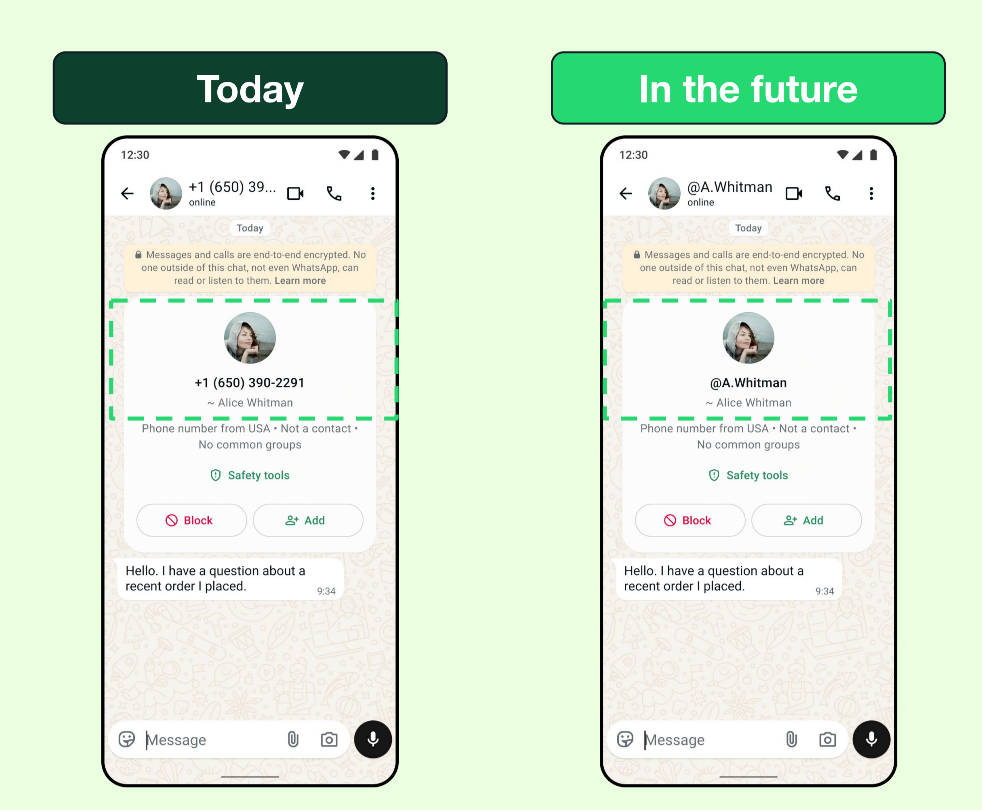
Usernames are an optional feature for users and businesses. If a username is adopted by a WhatsApp user, their username will be displayed instead of their phone number in the app. Business usernames are not intended for privacy, however. If you adopt a business username, it will not cause your business phone number to be hidden in the app.
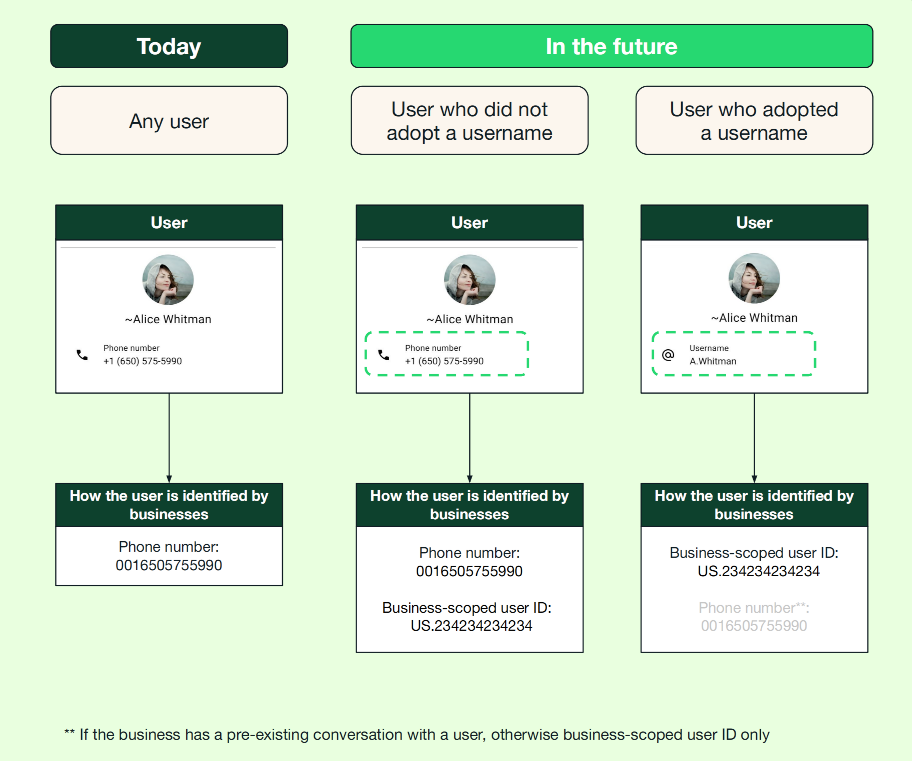
To support usernames, Meta will share a new backend user identifier called business-scoped user ID, or BSUID. BSUID uniquely identifies a WhatsApp user and is tied to a specific business.
User usernames
A user username is a unique, optional name that WhatsApp users can set in order to display their username instead of their phone number in the app. Usernames can be used in lieu of profile names when personalizing message content for individual users.
WhatsApp users are limited to 1 username, but are able to change them periodically. Changing a username does not affect the user’s phone number or business-scoped user ID, and does not affect the user’s ability to communicate with other WhatsApp users or businesses on the WhatsApp Business Platform.
Usernames are assigned to the username property in API responses and webhooks payloads. Once enabled, a WhatsApp user’s username will appear in all incoming messages webhooks, and all delivered and read status messages webhooks.
Business-scoped user ID
BSUIDs will begin appearing in webhooks starting March 31, 2026.
A BSUID is a unique user identifier that can be used to message a WhatsApp user when you don’t know their phone number. BSUID will be assigned to the user_id parameter and appear in all messages webhooks, regardless of whether or not the user has enabled the username feature.
BSUIDs are scoped to individual business portfolios. This means that any business phone number owned by a given portfolio can be used to message a BSUID scoped to the same portfolio, and attempts to message the BSUID using a phone number owned by a different portfolio will fail.
BSUIDs will be:
- generated automatically
- prefixed with the user’s ISO 3166 alpha-2 two-letter country code and a period, followed by up to 128 alphanumeric characters (for example, US.13491208655302741918)
- unique to each business portfolio-user pair (business portfolios were formerly known as Business Managers)
- regenerated if a user changes their phone number (which trigger a system status messages webhook)
BSUIDs can be used to send any type of message except for one-tap, zero-tap, and copy code authentication templates, which require user phone numbers.
When making API requests with BSUIDs, use the entire BSUID value: country code, period, and all alpha numeric characters. Omitting or changing the country code, period, or alpha numeric characters will cause your request to fail. If you are a managed business with multiple business portfolios, and want to use BSUIDs that will work across all of them, see Parent business-scoped user IDs.
Parent business-scoped user IDs.
If you are a managed business and want to link business portfolios, you can ask your Meta point-of-contact to check if you are eligible. If you are eligible, and your business portfolios become linked, parent BSUIDs will be included in all messages webhooks, assigned to a newparent_user_idproperty.
Parent BSUIDs can be used in place of regular BSUIDS to message users. Functionally, parent BSUIDs have the same properties as regular BSUIDs, but can be used by any business phone number within the set of linked portfolios.
Note that you can still message users using their regular BSUID scoped to your business portfolio.
Phone numbers
If a WhatsApp user enables the username feature, their phone number will not be included in webhooks, unless you have interacted with the user before, as explained below. Therefore, regardless of whether or not the user has enabled the feature, the user’s BSUID will be included in any webhooks that would normally include their phone number, assigned to a new user_id property.
To reduce the chance of losing conversation context with existing users who enable the usernames feature, user phone numbers will be included in webhooks if any of the following conditions are met:
- You have messaged or called the user’s phone number within the last 30 days of the webhook being triggered
- You have received a message or call from the user’s phone number within the last 30 days of the webhook being triggered
- You are in the user’s WhatsApp contacts list
- The user is in your contact book
BSUIDs will begin appearing in webhooks starting March 31, 2026. However, our APIs will not support sending messages targeted to the BSUIDs until May 2026 (exact date pending). Once our APIs support BSUIDs in May, you will be able to message users using either their BSUID, phone number, or both.
Requesting phone numbers from users
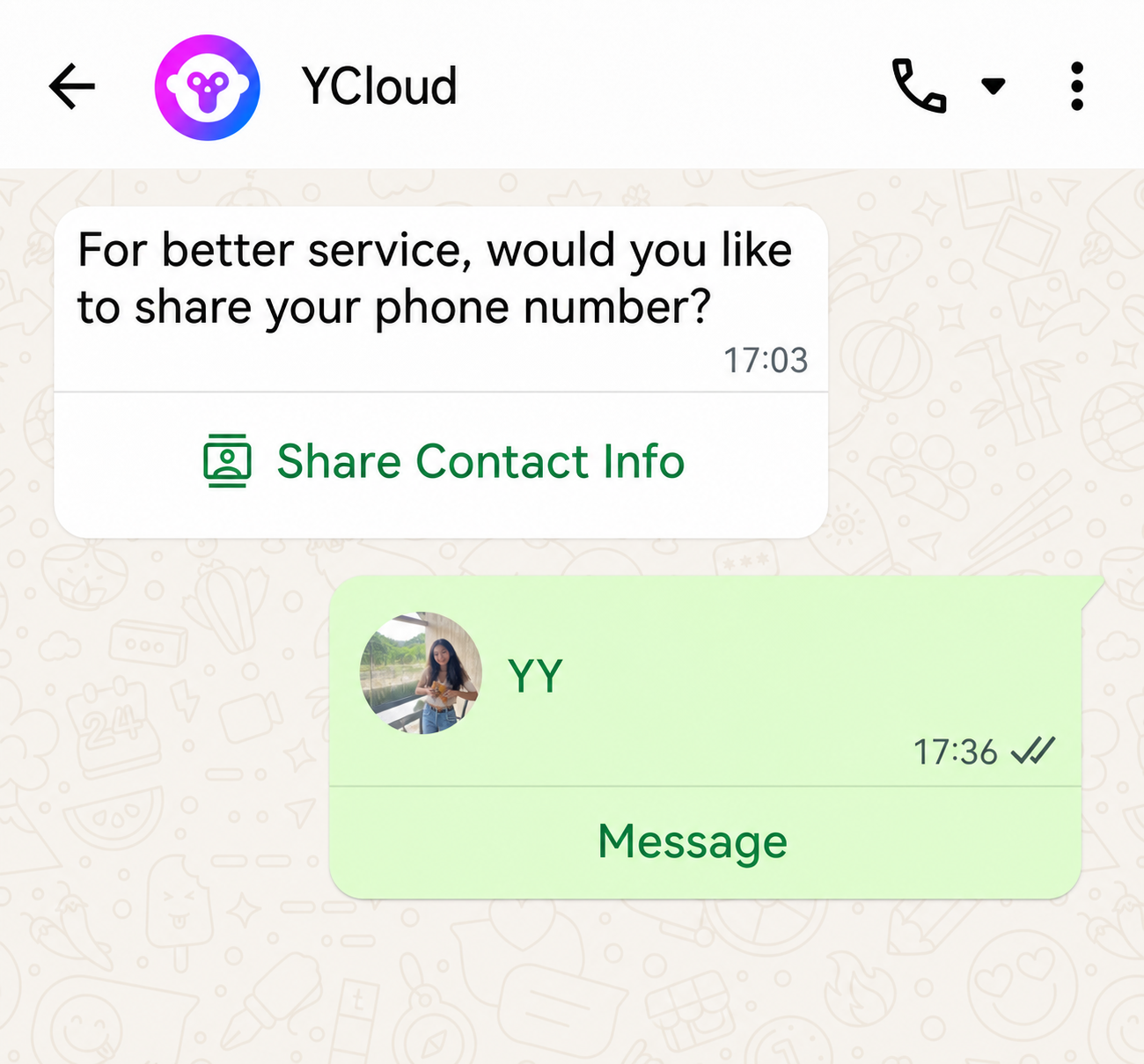
To make it easier to request phone numbers from WhatsApp users, a REQUEST_CONTACT_INFO button type is available that can be added to utility and marketing templates, or sent as an interactive message.
If a user taps this button, their WhatsApp phone number will be shared in the message thread, and a contacts webhook will be triggered containing the user’s phone number. Note that if a WhatsApp user shares a contact using the share contacts feature in the WhatsApp app instead, the webhook will also include the contact’s vCard.
If you are using the contact book feature, their phone number will also be added to your contact book automatically. For businesses that have enabled Local Storage, Meta extracts the user’s phone number from the shared contact card (vCard) and stores it in your contact book on Meta data centers. Only the phone number is extracted and stored; no other vCard data is retained beyond the standard data-in-use period.
Meta’s Contact book
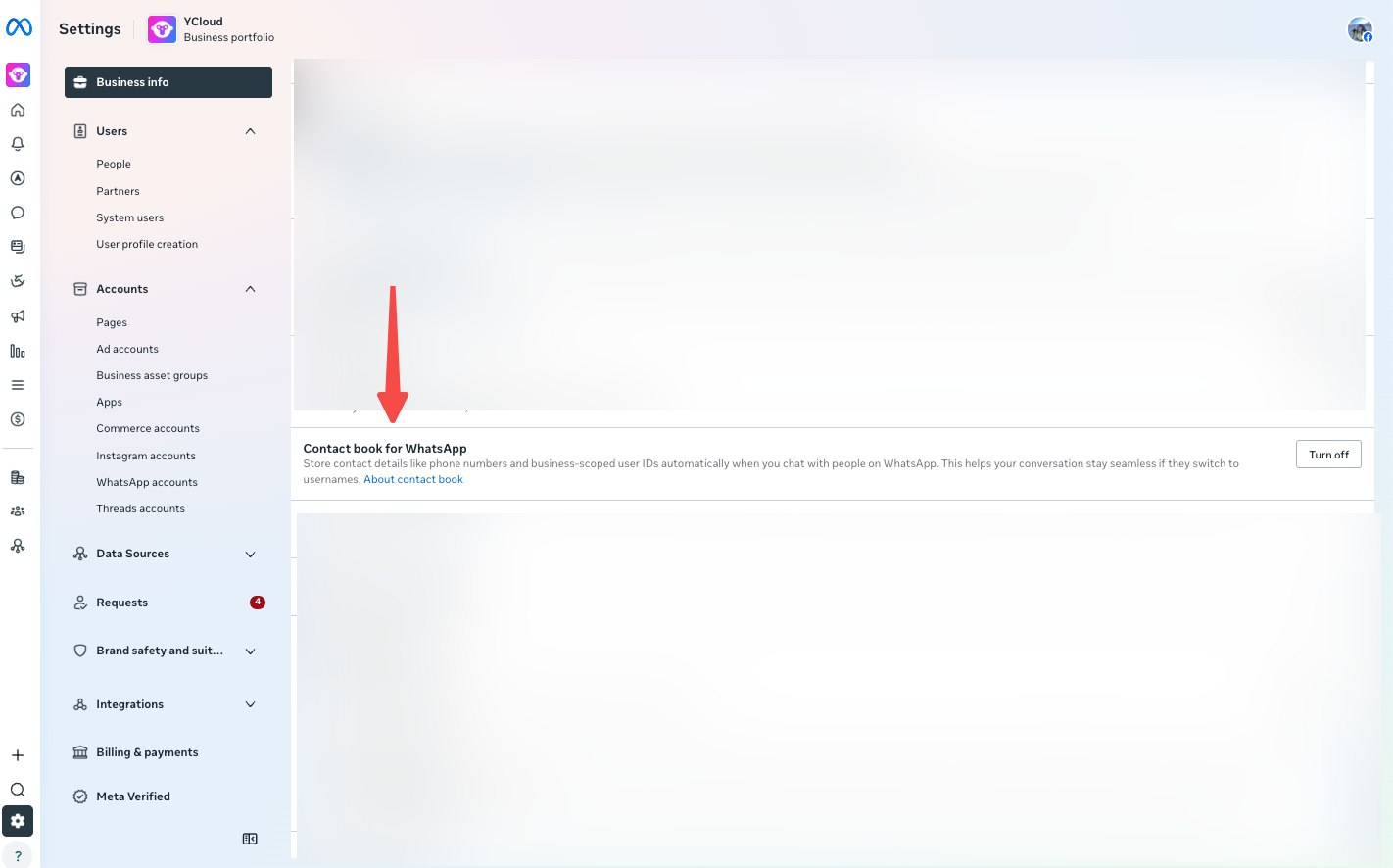
In early April 2026, to support messaging thread continuity, Meta’s contact book feature that stores WhatsApp user contact information is being released.
Once the feature is available, if you send a message/call to a user’s phone number, or receive a message/call from a user’s phone number, the user’s phone number and BSUID will be added to your Meta’s contact book. Once this data has been recorded, it will be used to populate any webhook payloads and API responses that include the user’s phone number or BSUID, regardless of whether or not the user has enabled the usernames feature.
Contact book data will be retained until you disable the feature, or deactivate your account. If you wish, you can disable this feature anytime after March 16, 2026, in the Meta Business Suite > Business settings > Business info panel. If you disable your Meta’s contact book, it will stop storing user information, and any existing user information it has already stored will be deleted. If you re-enable the contact book later, it will start storing user information again, but previously stored information cannot be restored.
Limitations:
- If you are using local storage and a user shares their phone number with you by tapping a request contact information button, the user’s contact information will not be added to your Meta’s contact book. Instead, send a message to the user’s phone number once it has been shared with you. This will cause their phone number and BSUID to be captured by your Meta’s contact book.
- Meta’s Contact books are scoped to business portfolios. This means that if you have linked portfolios, a user’s phone number and BSUID would have to be recorded to each portfolio’s Meta’s contact book independently; user contact information is not shared or synced across linked portfolios.
Country codes
If a WhatsApp user enables the username feature, their phone number (and thus, country dialing code) may not appear in webhooks. In these cases, the user’s BSUID will appear instead, prefixed with the user’s ISO 3166 alpha-2 two-letter country code (e.g., US.13491208655302741918).
Business usernames
Businesses will also be able to adopt a business username. If you adopt a business username, however, it will not cause your business phone number to be hidden in the WhatsApp or WhatsApp Business client.
Once a business username is claimed, customers can discover and contact your business directly by searching for your business username within WhatsApp, without needing your phone number, a click-to-chat link, or a QR code.
Meta will reserve eligible usernames for businesses based on their business identity, helping ensure that customers can easily find and recognize the correct business account.
A business username is mapped to a single business phone number across all of WhatsApp, i.e. a phone number can have only one username at a given time, and no two WhatsApp phone numbers (consumer or business) can have the same username.
Business usernames must adhere to the following format:
- may only contain English letters (a-z), digits (0-9), period (.) and underscore (_) characters
- must be between 3-35 characters in length
- must contain at least one English letter (a-z, A-Z)
- must not start or end with a period or have 2 consecutive periods
- must not start with www
- must not end with a domain (e.g., .com, .org, .net, .int, .edu, .gov, .mil, .us, .in, .html, and so on)
- case is ignored when comparing usernames, but period and underscore characters are not; for example, myID and myid are the same *username but myid, my.id, and my_id are all distinct
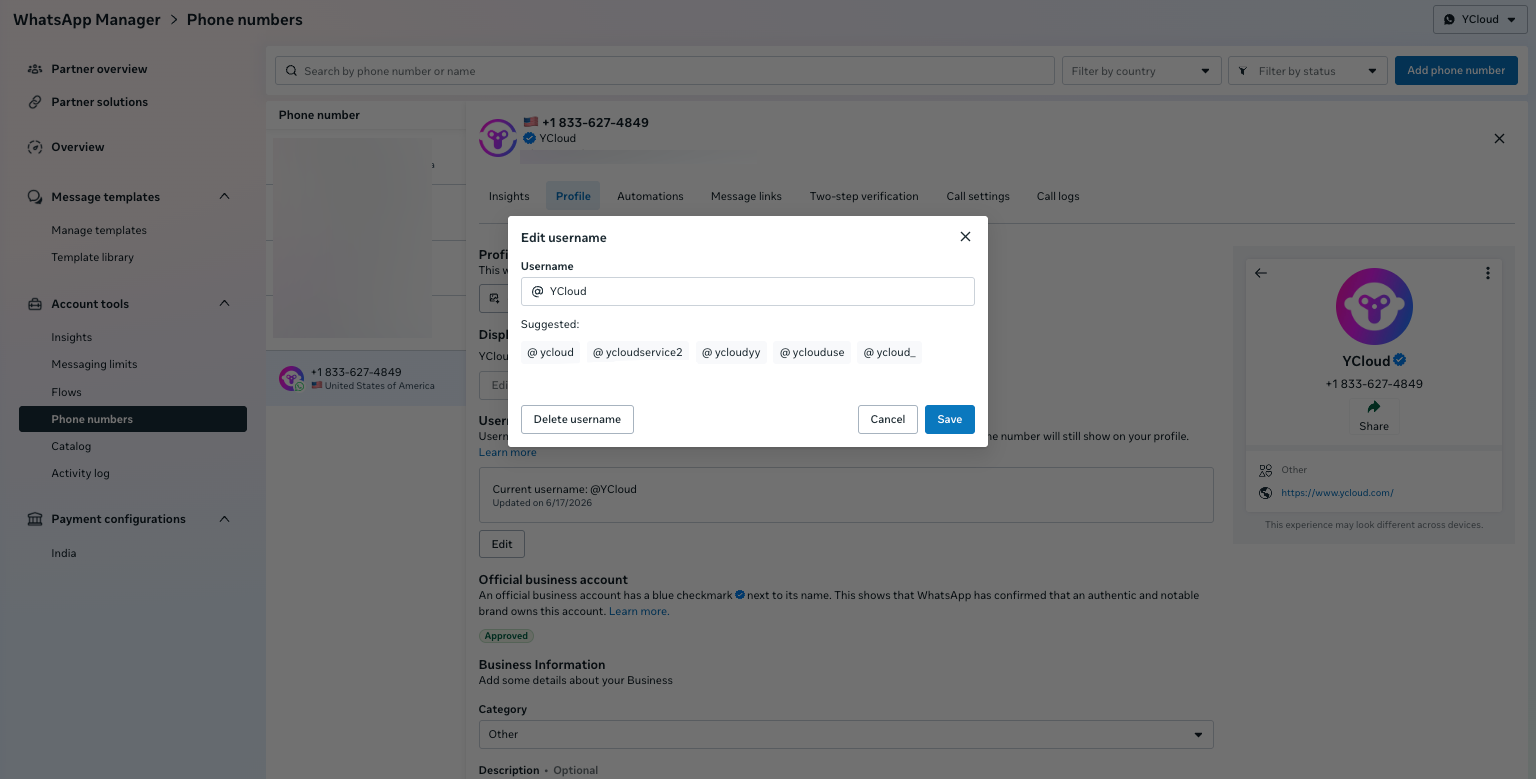
Reserved usernames
Before the username feature is made available, you will have the option to claim a username that WhatsApp has reserved for you. Alternatively, you can adopt a different username that aligns with your branding requirements. A reserved username can be claimed through WhatsApp Manager, Meta Business Suite, or via API. Claimed usernames that are approved will become active once the username feature is made available.
If a reserved username is already in use with your Facebook Page or Instagram account, you must link your business phone number to your Facebook Page or Instagram account before you will be able to claim the username.
You can link your phone number when claiming the username in Meta Business Suite or WhatsApp Manager, or by accessing your Facebook Page or Instagram account and adding your phone number directly.
To link your phone number, you must have full control of the page or account, or basic partial access with the manage_phone permission. See About business portfolio and business asset permissions for information about control/access and permissions.
Chat window display priority
The following priority will be followed (in decreasing order of priority) for displaying business profile information in chat windows in the app. Your business phone numbers will always appear in your business profile.
- Saved contact name
- Verified business name or Official Business Account name
- Username
- hone number