

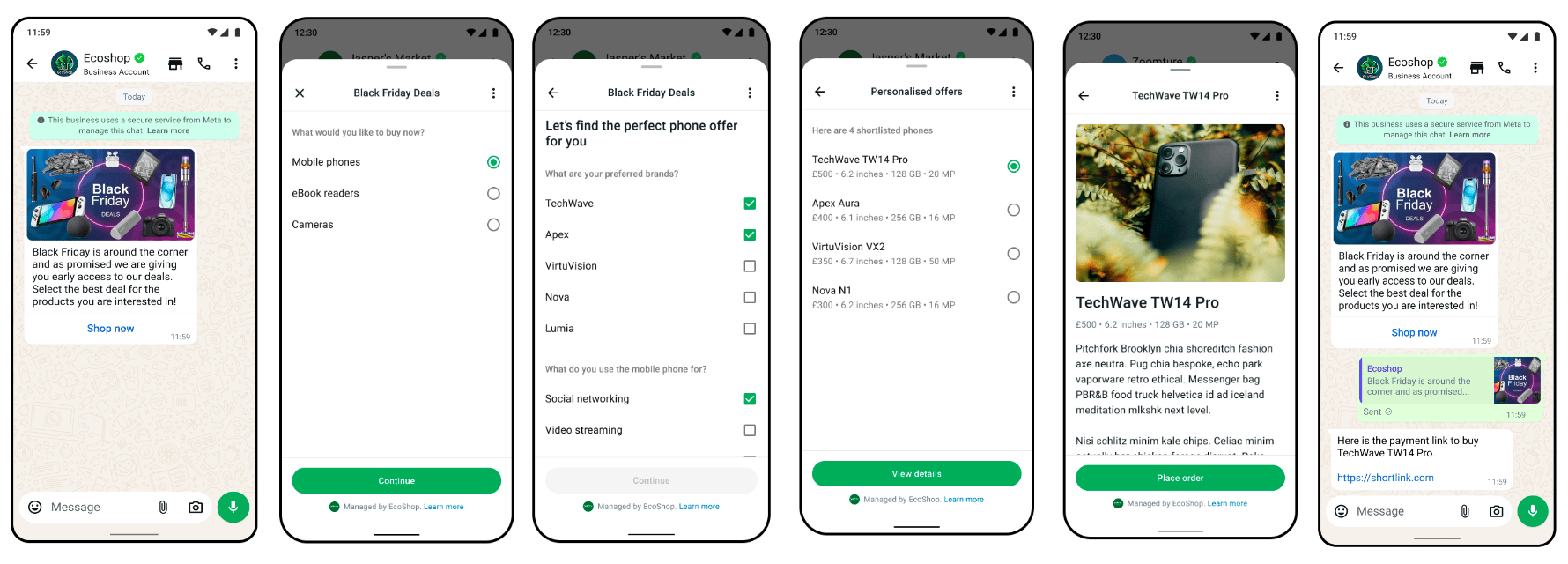
Meta example: a message opens a multi-screen Flow for product preferences and selection. This illustrates the customer experience, not YCloud's Flow editor.
Understand the building blocks
A Flow belongs to a WABA. Its definition describes screens, input fields, navigation, and completion behavior. Some Flows use data supplied when the message is sent. Others need a data endpoint to retrieve current information or process selections during the interaction. For example, an appointment Flow may collect the service, preferred date, and contact details. If it must show live availability, the endpoint and your booking system must coordinate that data. Meta provides Flows guides for screen design, endpoint integration, encryption, testing, and health monitoring.A Flow and its invitation are separate
You send a message that opens the Flow:- Use a supported interactive Flow message within an open service window.
- Use an approved template with a Flow button when a template is required.
Create, test, and release
YCloud’s Flows API guide covers creating, retrieving, updating, previewing, publishing, and deprecating Flows. Keep work in draft while validating the structure and testing the customer journey. Publishing is a lifecycle boundary; plan a replacement version when changing a live experience and check current API rules before attempting an in-place change. Test:- Required fields and invalid input.
- Back navigation and abandonment.
- Endpoint errors or unavailable appointments.
- Duplicate submissions.
- Completion messages and the next business action.
Example: an appointment request
A useful first version has three screens:
Use a static Flow if you only collect a preferred time for an agent to confirm later. Use an endpoint-powered Flow if the available choices must change with live inventory. Do not display a static list as guaranteed availability.
Write the completion screen to match the outcome. “Request received” is appropriate when staff still need to confirm; “Appointment confirmed” requires successful reservation in your booking system.
Keep the identifiers separate
- The Flow ID identifies the reusable form.
- The message ID identifies one invitation and its delivery.
- A Flow token, where supplied by your integration, associates the interaction with your business context.
- Your booking or application ID identifies the resulting business record.
Diagnose the right stage
These checks prevent a delivery problem from being confused with a form or booking problem.
Handle data deliberately
Collect only the information needed. Explain its use and provide relevant privacy information. For endpoint-powered Flows, follow Meta’s encryption and endpoint requirements. Keep secrets out of Flow JSON and public previews. Use synthetic data for tests. Save and process submissions in the correct customer context. Design duplicate handling so that a repeated submission cannot create two bookings or charges.Continue in YCloud
Keep Flow delivery, form submission, and the business outcome as separate measurements.Frequently asked questions
Do I need a backend endpoint for every Flow?
Do I need a backend endpoint for every Flow?
No. A static Flow can collect selections or information without fetching live data during each screen. Use an endpoint when choices or validation depend on current systems, such as available appointment slots. You still need to decide where completed responses go and who acts on them.
The customer submitted the form. Can I send an appointment-confirmed message immediately?
The customer submitted the form. Can I send an appointment-confirmed message immediately?
Only if your booking system successfully reserved the slot. A completed form can be a request rather than a confirmed booking. Use a request ID, validate availability, handle duplicate submissions, and make the confirmation wording match the actual result.
Can I use the same Flow for service replies and proactive outreach?
Can I use the same Flow for service replies and proactive outreach?
The form and its invitation are separate. Use an eligible interactive Flow message during the service window, or an approved template with a Flow button when a template is required. The invitation’s actual purpose determines its category; attaching a form does not make a promotional message utility.